“Insanity is hereditary. You get it from your children.” Sam Levenson
Indian conjugal obligations always includes having kids. It is about as fundamental as oxygen is to breathing and chocolate is to surviving. Nine months after the wedding, relatives start asking ‘Is everything is alright?’ Ten months into the marriage, not-so-subtle hints are dispensed whether a visit to a fertility specialist is in order. By eleven months, they suggest alternatives such as adoption.
It was a good thing I was eight thousand (seven hundred and six) miles away for inquisitive relatives to worry or care or poke their noses into my business. When I gave birth to a girl, an aunt wrote me a condolence letter with a ‘Better luck next time!’ message. Needless to say the bitch does not figure in my family tree and pendas were not delivered to her house when I had my son.
There were a lot of things I did not know about children. What I did know came from my father. He said children were God’s Gifts and that the three of us were perfect kids. Of course we were perfect for the two hours that we saw him every evening. He never asked Ba and the servants how ‘perfect’ we were for the other twenty-two hours.
So I thought I would have perfect little offspring. Hah!
They whined. They cried. They pooped. They threw tantrums. They said No! a lot. They were hungry when there was no food in sight, thirsty when only Perrier was available for the price of our hotel room. They needed to ‘go’ at the furthest point away from the bathroom. I remember a beautiful, (rare) sunny day in London when my sister and I had taken all the toddlers to Hyde Park for a stroll. My nephew Nikhil suddenly froze and yelled ‘Mamma! Chichi coming!’ I doubt whether Florence Griffith Joyner could’ve beaten my sister back to the hotel. This is when we fondly remember the motherland, when we could tell the kid to just ‘go’ behind a tree. It was very tempting to do the same here, leaving a shitty surprise for the incidental walker, who rightful in his indignation, would rail against the cursed dog owners who do not pick up after their pets. Though it would’ve given me great satisfaction to retaliate (in my own small way) for the two hundred years of shit Indians had to put up with during the British Raj.
If, being an Indian meant I HAD to get married, and I HAD to have kids, my contractual requirement as a mother did not include me HAVING to take them on vacation. But I did, because my father had said Travel was the Best Education. And hoo boy! Did I learn a lot!
By the time they hit their teens, they had already seen twelve countries. Most of the memories were pleasant and I wish I could say the bad ones were permanently erased, like they say about labor pains. But I should be so lucky. I remember booking tickets in Japan to Gion Corner for a concert. The kids slept through the whole thing, in spite of the repeated jabs to their sides and short of keeping their eyes open with toothpicks, there was nothing much I could do except kiss goodbye to the wads of cash I had spent. (Japan is so expensive. A banana comes wrapped in cellophane with a pretty pink bow and costs as much as Beluga caviar.)
The wads of cash however pales in comparison to what I spent to take them to Europe. Since I had already been thrice to France , it was obvious I was doing this purely out of a fervent desire to show my kids the Eiffel Tower. My daughter, however, had her eyes glued to the ground, furtively looking left and right. Look up! I said. Cool! she replied with a quick glance at the latticed iron tower (the one two hundred million have viewed with more than just a quick peek) and ... went back to counting cigarette butts. In Rome, my son fell asleep in the Colosseum (if he tells you otherwise, here is the photo to prove it). It was enough for me to wish the lions were still around – yes, I was that miffed. He woke up and we resumed the walking tour. While the group was taken with the fountains and the Forum, my son was fascinated with the variety of poop on the streets and repeatedly asked me for classification and identification. (Where were those damn lions?) So I brought them halfway across the world to see the two things we did not have on California sidewalks … cigarette ends and animal excrement.
In India, when I would have liked them to sleep more (so I could leave them with Sheilabai to go shopping), they were always wide-eyed and bushy-tailed, because this is where they had the time of their lives. Apart from all the love and attention they got and gave to the million relatives, I was hoping for them to imbibe a little Indian culture and learn the language. Hah! again. They roamed around in a chauffered Mercedes, drank filtered water, ordered take-out Dominoes Pizza, and played tennis at Willingdon Club. As for the language, the extent of my daughter’s Hindi is how to say ‘Ek glass thanda pani le ke ao’. And (in the car) ‘AC thoda kam karo’. My son gave up after mixing penda with Pandu (as in the servant), jaadu with jhaadu (as in the desi broom he brought back to the States), papad with thappad (which he got with regularity), bouddhi with buddhi (the brains he put on lay-away while on vacation.)
When my daughter left for college, I took her aside , much in the way Karamchand took Gandhi aside before he left for South Africa, and gave a pep talk on the evils of alcohol. (Someone should have warned Karamchand that liquor would be the least of his son’s problems). When I told her not to drink, she looked at me in disbelief. “Mom! I’m going to UC Santa Barbara! Would you tell the Pope not to pray when he went to church?”
I thought I would appeal to my son and knocked on his door. “Whaaat up, Dawg?” he yelled out. I took the ‘Matru Devo Bhave’ frame off his wall and walked out of the room. The ‘Dawg’ was easy to handle. A simple walk down a path would make me cringe. “Step on a crack, break your mother’s back!” they would cry and they hopped and jumped along the sidewalk. They were a bit late with the prediction. Carrying two babies the size of four bowling balls for eighteen months had already broken my back.
My daughter has always claimed she is ‘tough as nails’ and is a ‘survivor’. What does that mean for a girl who went to private schools, had her own room, and her own (brand-new, moon-roofed, leather seated) car for her sixteenth birthday? I got a frantic call one day from college that her bike didn’t work. Her mother who has no concept of tough love, drove the two and a half hours up north, to heave her bike in the trunk, to drive the four-hundred meters to the repair shop. The man took a look at the bike, took the handlebars, twisted them around and said, “That will be thirty-five dollars, please.” I’m not entirely sure he said ‘Please’, but I am positive about what I wanted to do to my tough, able-to-survive-on-my-own, daughter.
My son always wanted to be a doctor. From the time he could talk and was asked ‘What do you want to be when you grow up?’ he would reply ‘Doctor’. (Personally, I loved the idea of a cardiologist in the family - been overdoing the chocolates and cheese.) So he enters college, changes his major with every Monday night football game and ended up graduating with Geology. What kind of rocks and minerals he planned to find in the human anatomy is anyone’s guess. (And the closest a body can get to an earthquake is after indulging in street pani-puri in Bombay.) While we were in Guatemala, he tried to get us to climb one of the three active volcanoes to take some samples back for his class. The name ‘Fuego’ should have tipped us off as to its clear and present (explosive) danger. With thirty-three other dormant ones, he had to pick one involving fire, ash and toxic gases, viscous magma, flows of searing lava, chances of burning off the soles of my feet and frying my eyebrows at a minimum, and becoming desi grilled-kebab at worst. I told him the extra credit just wasn’t worth it.

So the doctor phase didn’t last long, although it ranked high amongst the ones I approved of. A statistic says that by the time a boy is twenty-one, he has spent a thousand hours playing video games. Hah! yet again. My son was sixteen by the time he had racked up the thousand playing Counterstrike. Then he went through the Elvis phase, the ‘I want to do up my room in Christina Aguilera phase’, ... and oh yes! the Poker Phase. My husband and I prayed a lot those days. But there was no counterpart of Lakshmi we could pray to, because we wished fervently for him to lose money, to ‘teach him a lesson’. Even though he did win enough to pay for a year of college.
So, even if my children aren’t perfect, they are perfect for me. And if they aren’t, they will have to be when they read this blog.
Or else.
A hodgepodge of rants :( , raves :), random musings, chronicles of my travels and experiences in my crazy but wonderful life.
Thursday, December 23, 2010
Wednesday, December 15, 2010
My Friend Mimi
“The average pencil is seven inches long, with just a half-inch eraser - in case you thought optimism was dead.” ~ Robert Brault
My room at the Asia Kaikan was the size of a matchbox. The bathroom was a wee bit smaller than that and if I held my breath, I could take a shower and if I stood on the potty, I could brush my teeth. I’ve seen thimbles larger than the sink. I mean I know Japanese are smaller than even Indians, but this was ridiculous.
The minimalism of the room, together with its Lilliputian dimensions forced me to spend much my stay in Tokyo in the hotel’s cafeteria-cum-lounge. Not many Indians stayed at the Asia Kaikan. Those who visited Japan in its heyday of the early 80s, had enough money to spring for a room at the Imperial Hotel. But even my father would’ve have balked at his daughter spending seven week’s worth of yen at the Imperial, so I resigned myself to the Asia Center. (A lot has changed from its Motel Sixish standing since then.)
I had been learning Japanese for two years and my dad had thought two months in Japan would have me speaking like a native. Obviously, he had no clue about how tough this language was. Mastering the Hiragana and Katakana alphabet was a piece of cake. But short of marrying a Jap and living several lifetimes in Japan, there was no way I was going to master Kanji - the Chinese script. (My Spanish friend Anabel tried to get a petition started to revoke the Kanji, but gave up after three signatures.) Speaking was a lot easier, and I could get around town with ease (even though there were no maps to be found, so why they would have a word for it beats me), order okonomiyaki or tempura in a restaurant and even shop (if you are taller than 5 feet and weigh more than 100 pounds, your credit card won’t leave your wallet). Discussing the establishment of the Bakufu in the Kamakura period or the intricacies of the theatrical tradition of Noh was a bit beyond me.
One morning, I noticed an Indian girl sitting all by herself in the cafeteria. One billion people in India, but the gravitation between desis who know each other is the equivalent of a 300-pound pull force of a neodymium magnet .
“Aren’t you Sheila Botawala’s daughter?” I asked. Yes, she answered, surprised that I knew her mother from the golf circle at the Willingdon Club. Since I was at loose end and had scouted out every nook and cranny of the city, I offered to show her around - how to exchange money, take the subway, and explore the areas of Shinjuku and Shibuya, Harajuku and Roppongi.
At the end of two days, she was ready to continue on to Mishima. I asked Mimi if she was confident to go by herself, since I had shown her the train station. “I didn’t see anything,” she replied.
What the hell was she talking about? Of all the ungrateful ... I hadn’t finished bud-budding, when she explained her predicament. She was visually impaired and had really not seen much of what I had shown her, but had enjoyed the whole experience to the max. I ended up accompanying her to the station and got the ticket collector to make sure she disembarked at the right stop in Mishima. Not that it would have been hard to track an Indian girl lost amongst 50,000 Mishimites (Mishimians?)
Mariam Botawala was diagnosed with macular degeneration at the age of 12. Credit goes to her parents who treated her no differently from her sister Shameem and encouraged her to do whatever she wanted and more. She played golf, learned Italian, French, Japanese, and went to boarding school. She worked with the Indian Tea Board in Brussels and went to all the international exhibitions in Europe promoting Indian tea.
These days she stays incredibly busy. She is an exercise addict, a relentless traveler and a devoted student of her guruji B.K.Iyengar. Yoga, she says, has given her inner strength and balance - needed to do the work she does. Together with her sister and her mother, she runs the D.M.Jariwala orphanage. The WeCan organization runs courses in computers, fashion designing, catering, health care, yoga, gardening, arts and crafts and the English language. The orphanage currently has 65 girls from the most backward classes and poverty-ridden society and gives them the skills to empower them to succeed in life.
Mimi is the eternal optimist and does not let her impairment impede her in any way. “I believe in counting my blessings,” she says. “How can I ever complain when I have so much to thank God for and I see so many people with bigger problems than mine.”
She looks at life through a prism that is perpetually rose-colored. Her cup not only runneth over, she shares what it contains with everyone else and her optimism is infectious.
The next time I whine about a zit on my face ( it was just before a wedding) or about losing a jacket (it was my favorite Ann Taylor one) or about an annoying bit of apple peel stuck in my teeth (no floss in my handbag), I shall think of my friend Mimi.
Tuesday, December 7, 2010
The Art of Desifying English
There are hundreds of languages in the world, but a smile speaks all.
“Chuchyu!” the girls at work would yell, and throw the negative back at us for a “re-kar”. If you didn’t understand, neither did they ... at first. While working at the One Hour Photo we owned, my husband and I would often slip in and out of two languages. Speaking macaronic English had the girls baffled till we taught them a few relevant Gujarati words. The English word ‘fluff’ just doesn’t cut it when you are explaining a bit of lint on the negative, which caused a white blur on the print. “Re-kar” was a Re-do.
I hear the Hispanics also have their own lingo or code-switching as it is officially called. An example: Since there was no place to parquear at the marketa, the nerdo and his amiga just went to hanguear out at his casa to studiar. However, Spanglish is easier to understand because of the cognates.
Not so with my language. Call it hybridization, bastardization, gujjufication or just plain Gujlish. It is not just a matter of anglicizing it and interspersing a word now and again. We are adept at conjugating Gujarati words à la anglais. We are good at shekofying jeera, bafoing daal, chalofying lot, talofying puris and vanofying rotlis, and can turn leftover rice into a vagharofied culinary masterpiece. The more time we expend in cooking, the less we spend manjoing the pots and pans and ghasoing the bathtub.
On the way home from a party, my young nephew Dhaval would ask plaintively, “Did I paj, Mom?” And his father would answer grimly, “I will let you know at home whether you pajjed or not.” What is the bet he got a thappad or two at home? I don’t know whether he had chadowed his younger brother or chavi-marowed him into doing something mischievous.
As I fold the clothes, I ask aloud “Whose chaddies are these?” My husband cringes. Why can’t you say ‘underwear’, he pleads. It’s too generic, I answer. Besides, would you rather I ask you and your son “Whose panties are these?” He cringes again, blushes and leaves the room.
We also tend to Gujjufy everything. Yosemite becomes Yashomati, tortillas become rotlis, chicken nuggets become bhajias, ouzo becomes valyari no liquor, tsatziki becomes raita. And don’t tell the French that we call crepes dhosas.
It doesn’t stop at Gujarati. All languages in India are fair game. If you can have Gujlish, Hinglish is not far behind. It is not uncommon to hear Bombayites bitch about stuff: “So I masca-maroed him a bit, gave him some chai-pani ka paisa and then only he did some proper bandobast.” We could give the Navajo Code Talkers a run for their money.
The Bombay patois includes butchering Hindi, thokoing Bollywood dialog and the liberal use of profanity - mc and bc, harami and halkat, sala and kamina. (My husband’s probably going to make me wash my pen with soap for using these words). And then you have the desi’s all-time favorite word ‘bloody’ - used as an adjective (‘He’s so bloody bindas!’), as a prefix (as in ‘bloodyidiot’ and ‘bloodyswine’), and as a tmesis (abso-bloody-lute gaddha). Gappa-maro-ing and doing altu-faltu talk wouldn’t get you into too much trouble with the local lafanga, but do enough fandagiri and dadagiri and it will evoke a menacing “I’ll give you one dhaap now, yaar!” or worse: “Abbey, Haramzade! Mere saath fuck mat kar!” If I were in this situation, I wouldn’t fafamaro, but hightail it out of there fatafut.
And speaking of Bollywood movie titles, they’ve got in the game as well: “Jab We Met”, “Love Aaj Kal” and “Love Khichdi”, “Aage Se Right’ and “Ao Wish Karein”. Even the song lyrics now switch back and forth between English and Hindi with ease, or even Spanish as in the case of the popular Jai Ho song from Slumdog.
Being bilingual comes extremely handy when you do not want to be understood by the goras. Unless of course you are dumb enough to say something like “Yeh waiter ekdum slow hai!” or dumber when exclaiming, “Abhi mat dekho. Bahut famous actor hai,” which is what happened when I saw one in a store in New York. Naturally, my friends whipped around immediately to gawk... and then got mad at me, because apparently Jeff Goldblum is not considered ‘a famous actor’ in their book. So sue me if I do not shop in the same stores as George Clooney.
The English language, in this case, is pretty much useless. As the official language in 53 countries and a third of the world’s population speaking it, you would probably have to go to some remote island (Palau?) if you wanted to use English as a secret code in one of your khitchdee blends. Which is why my kids and I use a mix of German and Gujarati. Try that on for size. Koi no phone avay, to kahe, ich bin nicht zu Hause. Would that make it Germarati or Gujarman?
Apparently everyone has gotten the hang of code-switching. Mix Spanish and Portugese and you get Portuñol; French and Japanese - weird as it sounds - gives you Franponais. I have heard a Japanese speak French and I swear I thought it was Swahili. Throw any two languages you want in a blender and you can come up with a salmagundi of strange combinations, some identifiable, some not. Finglish is obviously Finnish and English, and Serblish is Serbian and English, but Telegu and English gives you Tenglish and Tagalog and English gives you Englog.
As if 6800+ languages in the world were not enough.
Monday, December 6, 2010
The Tooshun Teacher
Children in India study all the time. They go to school five and a half days a week and average 235 days a year, in comparison to about 180 days for American schoolchildren. What they do have in common are the extremely heavy backpacks. My cousin Ushaben would send the servant along with the kids to carry their backpacks to school. Talk about coolie luxury.
There is enough homework given to ensure that any spare time at home, even weekends, is spent doing more of the rote learning and busy work. Ok, I admit the general knowledge instilled in us has come in use for yelling out answers during Jeopardy. We studied so much, even late into the night, that my father actually had to threaten us that he was going to turn off the lights if we didn’t stop studying. Yes, it was a bizarro world back then. After he carried out his threat, we would just turn them on again after he left the room and continue studying. And yes again, we were real nerds. There was no need to console us with ‘Oh well, if you don’t study, there is always the Working at McDonald’s' option that I would offer my own kids.
We learned addition, subtraction, division and multiplication...in first grade. Most sixth graders in the school where I work do not know their basic times table. The only ones I excuse are my special ed students. I once asked a young girl with SLD (Specific Learning Disability) that if her mother gave her one piece of candy and then gave her one more, how many would she have, only to have her wail, "My mom doesn’t allow me to eat candy!!” They don’t fare much better with spelling either. Three eighth graders wrote 'Homwork' in their agenda. When I corrected one of them, she had the gall to argue ‘But this is Math class’. And people ask why we rank 25th in the world. I’d tell you why, but that’s for another rant...I mean, blog.
Anyway, since my father had no time and Ba could not speak English, we needed to have extra ‘tooshun’...as it is pronounced in India. We had a tuition teacher for English, one for Maths (what we call Math) and one for Hindi to help us with our homework.
The first instructor my father hired was a combination of governess, teacher, disciplinarian ... and Emily Post.
Silloo Jilla was a pretty, young Parsi girl whose father gave her two options when she graduated from school: stay at home or become a teacher. It was a good thing for us that she chose the latter. She remembers holding Varsha and me as babies on her lap, while she taught Nina, who was barely five years old. She continued to teach us after getting married and had two children of her own. While she was pregnant, we went to her house after school. The house would be redolent of eggs and loban - the incense used by Parsis to dispel bad energy (and makes a wonderful insect repellent). The wonderful, heady aroma and the memory of the smoke emanating from the swinging afarganyu still takes me back to those evenings spent in her sitting room.
She taught us how to sit (Back straight!), how to stand (Shoulder’s back!), how to walk (Head high!) and how to behave (Please! Thank you! Excuse Me!). Nina was the ideal student, and was a pleasure to teach, which was good for Sillooauntie, given the energy spent on taming the two younger junglees.
Hearing the doorbell, Varsha and I would hastily throw a dress on our petticoats (young girls don’t go around in white slips), scurry into our chappals (young girls don’t walk around barefoot) and slick down our hair, which didn’t take long, given all that oil Vishnu administered to our tresses every morning.
We did our homework with her, recited poems by Wordsworth, soliloquies by Shakespeare, memorized our ‘times tables’ (multiplication up to twelve) and even learned how to eat with a knife and fork. Vishnu had also been instructed to save any food left on our plates and we were then made to eat it in front of her. Inedible when hot, it was nastier cold, and whereas Varsha often escaped because she had mastered the act of gagging well enough to earn her an Oscar, I would sit for hours, teary-eyed and miserable, strategically placed far away from soft-hearted Ba, lest she intervene on my behalf.
It is to Sillooauntie, however, that we owe the love of the English language and much more. All the supplementary intellectual stimulation has created in all three of us an addiction to reading and a profound thirst for general knowledge.
Some years ago, on my way to the airport to fly back to the States, on a sudden impulse, I asked the driver to stop at her building, near Babunath Temple. I guess she did not recognize me, given that I had stopped putting oil on my hair and had gained quite a few pounds. After introducing myself and thanking her for all her guidance, I sat there, teary-eyed once more, but out of gratitude.
Saturday, November 27, 2010
Ayahgate
Having two kids is great, but having three could have been better.
Coulda. Shoulda. Woulda.
Coulda, had I been younger.
Shoulda, because when both kids ganged up against me, it would’ve been nice to have the third one on my side.
Woulda, had I given birth to a nanny surgically appended to the third kid.
As it was, I returned the ayah back to India after my son turned four.
It was wonderful to have had help for four and a half years. There have been advantages and disadvantages, the former outweighing the latter by a few hundred degrees. A good comparison would be owning a Maytag, as opposed to going to the dhobighat to wash my clothes.
My lucky stars kicked in when my daughter was born. Along with a congratulatory silver cup, I got Janiben, an elderly Kutcchi lady, who was my father’s gift to the new mother and a substitute for Zoloft for postpartum depression.
It was a big relief to unload the eight-and-a-half pound baby off the 120-pound mothership. What I didn’t unload was the fanny-pack size of flesh around my middle. And if that didn’t depress me enough, the baby started crying non-stop, every evening, for no discernible reason. Colic is what it was and it started at eight and ended on the dot at eleven, with the kind of precision the Swiss set their watches by.
Anyone who has held a screaming baby for three hours will understand my fervent desire to throw her in the diaper pail. "Open it!” I told my husband as I stood over the plastic bin. “You don’t mean it,” he said. “Watch me”, I answered. (In addition to postpartum depression, I admit there was a touch of insanity.)
And that’s where she would have ended up, were it not for Janiben ... and my mother-in-law, my father-in-law, my sister-in-law, and let’s not forget the doting father. Talk about a support system. Why would I have even wanted the Three Magi when I had five pairs of eager, loving hands to snatch the Divine Infant from (the frazzled, neurotic) mother?
All I did was feed her. The rest was up to my posse.
But six months later everyone was gone - to Bombay, to New York, back to work. I was handed my baby with no instruction manual.
As they say, everyone survives, and so did my baby. I learned the ropes - and even how to bathe her. Long story. The short of it is that I didn’t bathe her for three days, because Janiben wasn’t there. And I didn’t know how. (Surprising how my daughter still holds a grudge against me for this till today.)
But then I got pregnant again.
This time no silver cup, but I did get another ayah - this time from Bangalore. And after her visa was up, I took Sabina back to India and decided to bring Janiben back with me.
Except this time, she came on a visitor visa. As my ‘aunt’. Upon landing at LAX, we were hauled into the Immigration/Interrogation Room. A severe-looking lady-officer in uniform wanted to ask some questions. Sure, I said, but my aunt doesn’t speak English, nor Hindi (wink, wink) and we would need a Gujarati interpreter. A voice boomed over the intercom for a Goo-shaa-rate-ee person, but Gujjus apparently find other professions more lucrative, and no one showed up. Or else they had no idea what a Goo-shaa-rate-ee was.
Ms Stony-Face Officer asked me to translate. Sure, I said agreeably.
“Ask your aunt how long she is here for”. I translated with due diligence, except with a little addition of my own. Ketla vakhat matay avya cho? Beh mahina kaho (Say two months). “Beh mahina”, answered Janiben obediently.
“Ask your aunt why she has come here”. Kem avya cho? Bhana na lagan matay kaho (Say for my nephew’s wedding). “Bhana na lagan matay,” continued Janiben.
And so it went. The officer would have caught on, if she had even heard the answers.
My two-year old son, who had just about enough of the 22-hour flight from India and of the small, stuffy room, was busy shrieking his head off, and throwing a full-on tantrum on the floor, complete with fist-pounding and leg-kicking.
There are few times in my life when I have been prouder of my son. Ok, so maybe when he got straight As all through school, awards in high school, scholarships in college, a Master’s degree and a great job - the last two in the offing, but still...
“Whose baby is this?” the Capo of Immigration came in, furious at the ruckus.
There are many times in my life when I have been reluctant to claim my son. When he lost his credit card, banged up the car, got caught for underage drinking ... But the moment the Capo barked out an order to pick the brat up and get the hell out of the office, we complied and scrammed before I could say Nyah-ni, Nyah-ni to Ms Stony-Face.
We sent Janiben back after two years, and since then, I have been nanny-less. Sure, I miss her baby-sitting skills, but she was also an awesome cook. I miss having garam-garam rotlis - heck, I miss having rotlis, period. (Tortillas are a good enough substitute).
But with a wonderful husband who helped (without asking), and obedient children who did their chores (without nagging), life went on without a hiccup.
My only regret is that it ruined any chances of my career as a politician. Just ask Zoë Baird and Meg Whitman.
Coulda. Shoulda. Woulda.
Coulda, had I been younger.
Shoulda, because when both kids ganged up against me, it would’ve been nice to have the third one on my side.
Woulda, had I given birth to a nanny surgically appended to the third kid.
As it was, I returned the ayah back to India after my son turned four.
It was wonderful to have had help for four and a half years. There have been advantages and disadvantages, the former outweighing the latter by a few hundred degrees. A good comparison would be owning a Maytag, as opposed to going to the dhobighat to wash my clothes.
My lucky stars kicked in when my daughter was born. Along with a congratulatory silver cup, I got Janiben, an elderly Kutcchi lady, who was my father’s gift to the new mother and a substitute for Zoloft for postpartum depression.
It was a big relief to unload the eight-and-a-half pound baby off the 120-pound mothership. What I didn’t unload was the fanny-pack size of flesh around my middle. And if that didn’t depress me enough, the baby started crying non-stop, every evening, for no discernible reason. Colic is what it was and it started at eight and ended on the dot at eleven, with the kind of precision the Swiss set their watches by.
Anyone who has held a screaming baby for three hours will understand my fervent desire to throw her in the diaper pail. "Open it!” I told my husband as I stood over the plastic bin. “You don’t mean it,” he said. “Watch me”, I answered. (In addition to postpartum depression, I admit there was a touch of insanity.)
And that’s where she would have ended up, were it not for Janiben ... and my mother-in-law, my father-in-law, my sister-in-law, and let’s not forget the doting father. Talk about a support system. Why would I have even wanted the Three Magi when I had five pairs of eager, loving hands to snatch the Divine Infant from (the frazzled, neurotic) mother?
All I did was feed her. The rest was up to my posse.
But six months later everyone was gone - to Bombay, to New York, back to work. I was handed my baby with no instruction manual.
As they say, everyone survives, and so did my baby. I learned the ropes - and even how to bathe her. Long story. The short of it is that I didn’t bathe her for three days, because Janiben wasn’t there. And I didn’t know how. (Surprising how my daughter still holds a grudge against me for this till today.)
But then I got pregnant again.
This time no silver cup, but I did get another ayah - this time from Bangalore. And after her visa was up, I took Sabina back to India and decided to bring Janiben back with me.
Except this time, she came on a visitor visa. As my ‘aunt’. Upon landing at LAX, we were hauled into the Immigration/Interrogation Room. A severe-looking lady-officer in uniform wanted to ask some questions. Sure, I said, but my aunt doesn’t speak English, nor Hindi (wink, wink) and we would need a Gujarati interpreter. A voice boomed over the intercom for a Goo-shaa-rate-ee person, but Gujjus apparently find other professions more lucrative, and no one showed up. Or else they had no idea what a Goo-shaa-rate-ee was.
Ms Stony-Face Officer asked me to translate. Sure, I said agreeably.
“Ask your aunt how long she is here for”. I translated with due diligence, except with a little addition of my own. Ketla vakhat matay avya cho? Beh mahina kaho (Say two months). “Beh mahina”, answered Janiben obediently.
“Ask your aunt why she has come here”. Kem avya cho? Bhana na lagan matay kaho (Say for my nephew’s wedding). “Bhana na lagan matay,” continued Janiben.
And so it went. The officer would have caught on, if she had even heard the answers.
My two-year old son, who had just about enough of the 22-hour flight from India and of the small, stuffy room, was busy shrieking his head off, and throwing a full-on tantrum on the floor, complete with fist-pounding and leg-kicking.
There are few times in my life when I have been prouder of my son. Ok, so maybe when he got straight As all through school, awards in high school, scholarships in college, a Master’s degree and a great job - the last two in the offing, but still...
“Whose baby is this?” the Capo of Immigration came in, furious at the ruckus.
There are many times in my life when I have been reluctant to claim my son. When he lost his credit card, banged up the car, got caught for underage drinking ... But the moment the Capo barked out an order to pick the brat up and get the hell out of the office, we complied and scrammed before I could say Nyah-ni, Nyah-ni to Ms Stony-Face.
We sent Janiben back after two years, and since then, I have been nanny-less. Sure, I miss her baby-sitting skills, but she was also an awesome cook. I miss having garam-garam rotlis - heck, I miss having rotlis, period. (Tortillas are a good enough substitute).
But with a wonderful husband who helped (without asking), and obedient children who did their chores (without nagging), life went on without a hiccup.
My only regret is that it ruined any chances of my career as a politician. Just ask Zoë Baird and Meg Whitman.
Monday, November 15, 2010
The Birthday Parties
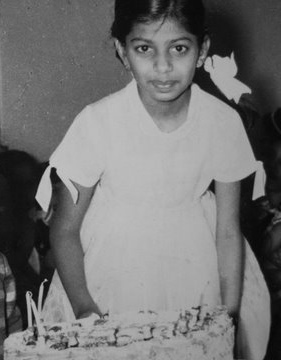
Nina and Varsha’s birthdays fell within a week of each other, in January. The whole concept of a birthday party was alien to Ba, never having given one to any of her kids, let alone knowing exactly which day they were born. The question was, who would order the cake, put up decorations, organize the games and get new party dresses?
Enter Shashikala.
Shashikala, a well-known actress and famous for her roles as a vamp in Hindi movies, was a good friend of the family. She would traipse into the house, her two daughters and a trail of perfume in her wake. She took command. Balloons and streamers. Cake and wafers. Party dresses and conical hats. She would organize and arrange, order and direct everyone and everything around her to produce the ultimate kiddie party.
My dad’s only job in all this was to get the projector from Central Camera and order movies of Laurel and Hardy. The reels would come a day before, five or six of them in big silver tin cases. We all sat on the living-room floor in the diwankhana, our pretty, fluffy dressed fanned around us. Friends, family and neighbors, all invited. The younger kids sat on their ayah’s laps, ayahs who hoped their young charges would not cry, resulting in both being expelled from the room.
Vishnu, servant extraordinaire and general factotum, would set up the projector, threading the film, weaving the celluloid through a veritable maze of buttons and clips, winding, twisting, and turning, snapping shut the clips that would hold the film. It would often slither out of the allotted retaining clasp and the projector would start spewing film - celluloid flailing and thrashing around, a snake in the mouth of a mongoose. A disappointing Ohhh! would reverberate through the room, with Vishnu shouting for the lights and patiently starting the whole weaving process again. The lights would be dimmed again and the show would go on.
Nina and Varsha’s show that is.
My birthday fell in September. No party, no presents, no balloons. No Laurel. No Hardy.
No Shashikala.
September was when the cursed Leipzig Trade Fair took place. And it always took place towards the end of September, when Dad had to make the trip to East Germany. Vishnu would get his bags ready, and off he went, my party the last thing on his mind.
It’s not that he didn’t love me; after all, I was his favorite child. This, in itself, was bigger than any dumb parties or presents, I would reason.
One year, the reasoning quotient ran out and I remember throwing a fit. He cancelled the Leipzig trip and I had my party. He never let on what it cost him and gave me my shining moment the September of that year.
Whereas we were always gently discouraged from having friends (cousins being company enough), attending their birthday parties was charitably allowed. Lobo would drive us there and wait patiently outside, socializing with the other waiting drivers. At the really affluent parties, the hostess would send the house servant out with platters of the ubiquitous wafers and cake for them as well.
Even here, I ran out of luck. The birthday parties I got invited to were boring as hell, where everyone sat on the couches in our stiff, scratchy dresses, staring vapidly at one another, till the mother decided we should play some games. We would sit on the floor and play Passing the Pillow and I Wrote a Letter to my Lover.
I kid you not. Seven year-olds singing about writing letters to lovers. I didn’t even know what a kiss was, let alone a lover. These days any four-year old will not only describe it in lurid detail, but also which boy they french-kissed.
The game involved a circle of kids on the floor and one girl skipping behind them, singing “I wrote an letter to my lover, and on the way I dropped it,” and surreptiously dropping a handkerchief (substituting for the lover’s letter) behind one girl.
I am bored out of my mind just describing it.
Of course, Varsha got the good parties. One year her friend took her to the circus (her father owned Eagle Flasks). Another friend invited her on a ship (her father owned a steamship company).
And I skipped and hopped and dropped handkerchiefs, all the while believing I was having the time of my life.
Thursday, November 4, 2010
The Holidays
If our daily life was well taken care of, there were still those holidays to bear in mind. How could my Dad have kept his three girls safely entertained for two months of summer and two weeks of Diwali and Christmas, without having the servants threaten to quit and without driving his aging mother into an ashram?
The problem was easily solved by shipping us off to a different spot every year. These were some of the best times of our lives. Each house my dad chose was in a spot conducive to running wild in nearby fields, forests and tea plantations, expending energy and building up voracious appetites.
Often, Anandfoi’s and Madrasfoi’s children would join us, as well as my WhiteHouse ‘cousins’. It was effectively an open invitation to an open house with open arms.
One year he packed everyone in two cars for a tour of South India. ‘Everyone’ was his mother (my Ba), his sister (my Madrasfoi), eight kids (five of hers + three of us), a servant (Vishnu), two dogs (Sweety and Rita), and a manager and his son. I presume he forgot the kitchen sink, or that would have sat in the dickey, together with the gaadlas that I forgot to mention.
When I was about ten, he rented a house in the nearby, pastoral town of Khandala. A huge sprawling bungalow, it sat atop a small hill and had a front yard the size of a small park, which had enough space for a wild bunch of rambunctious kids. A good breakfast in our bellies and off we went, scampering down the slope to the edge of the river, eating jambus from the trees, tongues turning purple and mouths puckering with the sour taste. My Foi recalls how just as residuum of the breakfast mess had been cleared up, we were back, disheveled and dirty, tired and hungry for more food. Never once did we hear a sigh of exasperation, a word of complaint nor signs of displeasure from her; not even felt the back of a hand on a backside, a punishment meted out in other families with abandon in those days.
One afternoon, we had a visitor from the neighboring house. Had I known who the famous visitor was, I woulda (coulda, shoulda) taken a picture with him, plus gotten his autograph for my husband - who thinks the sun rises and sets on the Indian screen with - Dilip Kumar. So he came over for tea and except for my father, none of us kids gave him more than a cursory glance, before we ran off to play. Another afternoon, the actor Agha, on a visit to the same said famous actor, sent his daughter over to play with us. As entertainment, she told us ghost stories and at a momentous part in her horrifying tale-telling, the cow in the adjacent yard gave a loud moo, which sent us screaming into the house in our best Home Alone impression.
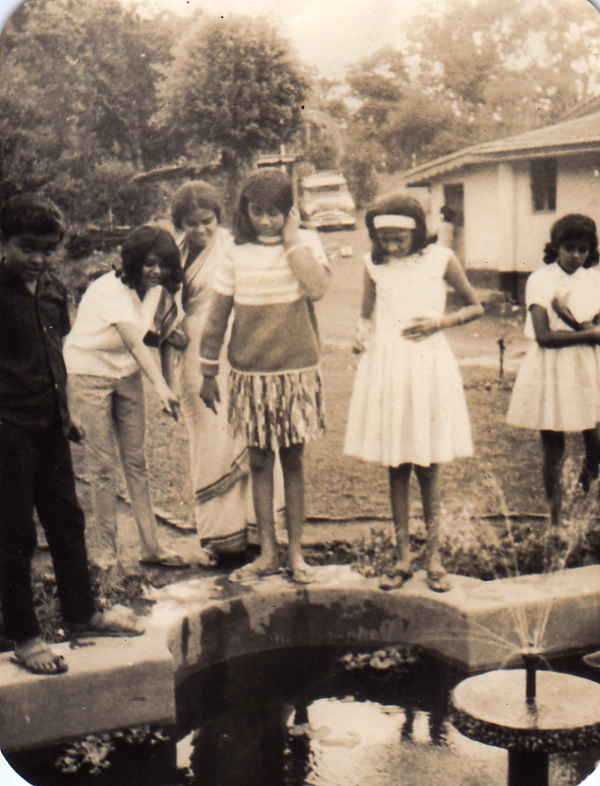
Coonoor was where I learned to ride a bike. It was also when I fell into the pond outside the house and the experience of the slimy algae against my skin and the stinky fishies nibbling at my toes is the reason I swim only in severely chlorinated, man-made creations. The memory of the laughter of my siblings and my cousins as I thrashed around is the reason I still hold a grudge ... not to mention that no one lent a helping hand till Vishnu pulled me out.
The vacation in Mussoorie was memorable, special in the way that one of the cousins (I think it was Maya?) got the mumps and then generously proceeded to give it to the rest of the brood. Her mother, Padmabhabhi, turned up to look after us and turned the living room into a dormitory-style ward. For two weeks, we lay in bed, a chip-munked brood of kids, proving the fact that misery loves company.
In 1960, the year before he died, Motakaka took charge of the family vacation. He organized a trip to Delhi and to Kashmir, with: two daughters, two grandkids, a mother, a brother and his three girls.
And a family photographer.
Most people take a camera, but Motakaka was not most people and he took a cameraman along to record the memories for posterity.
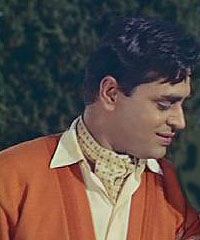
Except that the photographer was a serious nature lover, and most that posterity can see in the 8mm film (since transferred to DVD) of that vacation, is hours and hours of idyllic Kashmiri gardens, Dal Lake and exotic flowers, and just a few paltry minutes of the family. The photographer apparently, like most others, was also an avid movie fan. We happened by chance to meet a good friend of Motakaka’s, who was also vacationing with his family. The ‘good friend’ was the famous actor Rajendra Kumar. Subsequent footage reveals the actor playing with his children, playing golf with my father, playing cards with the family and we are rarely seen again, unless as incidental scenery in the background.
The holidays continued well into my twenties ... sometimes with and sometimes without my father.
Without my father, holidays were full of fun. Fun enough not to share details with him nor the photographs. Innocent enough by today’s standards but still, involving disco dancing, late nights and gasp! alcohol.
With my father, the holidays were full of surprises. I once accompanied him to Hong Kong for a three-day trip. With his typical, lackadaisical, ‘God will look after us’ logic, he had not made a hotel reservation, assuming his Hyatt Gold Card would be guarantee enough to secure lodgings of a decent sort for the night. He assumed wrong and one of the biggest conventions ever held in the history of Hong Kong meant even his Hyatt Gold Card was nothing more than a useless piece of plastic.
So, this being the pre-, pre-internet days (in fact pre-computer years), after trudging up and down the streets for a couple of hours, he considered catching the next plane back to Bombay. Totally adverse to the thought of sitting on another seven-hour flight, I convinced him we could just stay in one of the (shudder) Chinese hotels. The room had two beds and a window. It barely had a (dirty) floor and don’t even ask about the minibar. We slept with our clothes on, my father with one eye open and I fell asleep listening to him apologize for the millionth time.
An addendum to the story is that the next day, the Hyatt Gold Card reverted to its fairy godmother status and we were whisked up to the Penthouse Suite. This time we got not only a minibar...but towels as well.
The problem was easily solved by shipping us off to a different spot every year. These were some of the best times of our lives. Each house my dad chose was in a spot conducive to running wild in nearby fields, forests and tea plantations, expending energy and building up voracious appetites.
Often, Anandfoi’s and Madrasfoi’s children would join us, as well as my WhiteHouse ‘cousins’. It was effectively an open invitation to an open house with open arms.
One year he packed everyone in two cars for a tour of South India. ‘Everyone’ was his mother (my Ba), his sister (my Madrasfoi), eight kids (five of hers + three of us), a servant (Vishnu), two dogs (Sweety and Rita), and a manager and his son. I presume he forgot the kitchen sink, or that would have sat in the dickey, together with the gaadlas that I forgot to mention.
When I was about ten, he rented a house in the nearby, pastoral town of Khandala. A huge sprawling bungalow, it sat atop a small hill and had a front yard the size of a small park, which had enough space for a wild bunch of rambunctious kids. A good breakfast in our bellies and off we went, scampering down the slope to the edge of the river, eating jambus from the trees, tongues turning purple and mouths puckering with the sour taste. My Foi recalls how just as residuum of the breakfast mess had been cleared up, we were back, disheveled and dirty, tired and hungry for more food. Never once did we hear a sigh of exasperation, a word of complaint nor signs of displeasure from her; not even felt the back of a hand on a backside, a punishment meted out in other families with abandon in those days.
One afternoon, we had a visitor from the neighboring house. Had I known who the famous visitor was, I woulda (coulda, shoulda) taken a picture with him, plus gotten his autograph for my husband - who thinks the sun rises and sets on the Indian screen with - Dilip Kumar. So he came over for tea and except for my father, none of us kids gave him more than a cursory glance, before we ran off to play. Another afternoon, the actor Agha, on a visit to the same said famous actor, sent his daughter over to play with us. As entertainment, she told us ghost stories and at a momentous part in her horrifying tale-telling, the cow in the adjacent yard gave a loud moo, which sent us screaming into the house in our best Home Alone impression.
Coonoor was where I learned to ride a bike. It was also when I fell into the pond outside the house and the experience of the slimy algae against my skin and the stinky fishies nibbling at my toes is the reason I swim only in severely chlorinated, man-made creations. The memory of the laughter of my siblings and my cousins as I thrashed around is the reason I still hold a grudge ... not to mention that no one lent a helping hand till Vishnu pulled me out.
The vacation in Mussoorie was memorable, special in the way that one of the cousins (I think it was Maya?) got the mumps and then generously proceeded to give it to the rest of the brood. Her mother, Padmabhabhi, turned up to look after us and turned the living room into a dormitory-style ward. For two weeks, we lay in bed, a chip-munked brood of kids, proving the fact that misery loves company.
In 1960, the year before he died, Motakaka took charge of the family vacation. He organized a trip to Delhi and to Kashmir, with: two daughters, two grandkids, a mother, a brother and his three girls.
And a family photographer.
Most people take a camera, but Motakaka was not most people and he took a cameraman along to record the memories for posterity.
Except that the photographer was a serious nature lover, and most that posterity can see in the 8mm film (since transferred to DVD) of that vacation, is hours and hours of idyllic Kashmiri gardens, Dal Lake and exotic flowers, and just a few paltry minutes of the family. The photographer apparently, like most others, was also an avid movie fan. We happened by chance to meet a good friend of Motakaka’s, who was also vacationing with his family. The ‘good friend’ was the famous actor Rajendra Kumar. Subsequent footage reveals the actor playing with his children, playing golf with my father, playing cards with the family and we are rarely seen again, unless as incidental scenery in the background.
The holidays continued well into my twenties ... sometimes with and sometimes without my father.
Without my father, holidays were full of fun. Fun enough not to share details with him nor the photographs. Innocent enough by today’s standards but still, involving disco dancing, late nights and gasp! alcohol.
With my father, the holidays were full of surprises. I once accompanied him to Hong Kong for a three-day trip. With his typical, lackadaisical, ‘God will look after us’ logic, he had not made a hotel reservation, assuming his Hyatt Gold Card would be guarantee enough to secure lodgings of a decent sort for the night. He assumed wrong and one of the biggest conventions ever held in the history of Hong Kong meant even his Hyatt Gold Card was nothing more than a useless piece of plastic.
So, this being the pre-, pre-internet days (in fact pre-computer years), after trudging up and down the streets for a couple of hours, he considered catching the next plane back to Bombay. Totally adverse to the thought of sitting on another seven-hour flight, I convinced him we could just stay in one of the (shudder) Chinese hotels. The room had two beds and a window. It barely had a (dirty) floor and don’t even ask about the minibar. We slept with our clothes on, my father with one eye open and I fell asleep listening to him apologize for the millionth time.
An addendum to the story is that the next day, the Hyatt Gold Card reverted to its fairy godmother status and we were whisked up to the Penthouse Suite. This time we got not only a minibar...but towels as well.
Subscribe to:
Posts (Atom)